+923554945378
[email protected]

If there is a place on earth where nature has truly outdone itself, it is Gilgit-Baltistan. This stunning region lies in the far north of Pakistan, where three of the world’s greatest mountain ranges—the Himalayas, the Karakoram, and the Hindu Kush—meet. It is a country of dizzying heights, ancient forts, turquoise lakes, roaring glaciers, and some of the warmest hospitality you will ever experience.
There are more reasons than ever to visit Gilgit-Baltistan in 2026. Eight of the world’s seventeen highest peaks are within the territory’s borders; trekking routes range from easy valley strolls to demanding high-altitude expeditions; and visitor numbers are still vastly lower than comparable destinations in Nepal or India, so solitude is really possible.
Whether you are an adventure seeker, a landscape photographer, a history lover, or just someone looking for a place that will change you forever, the destinations in Gilgit-Baltistan to visit in 2026 have something truly extraordinary. Here’s your definitive guide.
 No list of destinations in Gilgit-Baltistan would be complete without Hunza Valley. This is the destination that first put northern Pakistan on the global tourism map, and it continues to dazzle visitors year after year.
Hunza Valley is known for its beautiful vistas, colourful orchards of apricots, and friendly local communities. Baltit Fort and Altit Fort are centuries-old architectural wonders that offer panoramic views of the valley below. The Karimabad Bazaar offers a great opportunity to experience local life and shop for handicrafts.
The iconic Eagle’s Nest viewpoint in Duikar offers one of the most photographed sunsets in Pakistan, with the golden light washing over Rakaposhi, Ultar Sar, and Lady Finger peaks simultaneously. The nearby Attabad Lake, a turquoise-colored lake formed by a massive landslide, is perfect for boating, photography, and outdoor activities, while the Passu Cones are a stunning natural attraction that nature lovers simply cannot miss.
Spring is one of the most visually stunning times to visit Hunza, as the valleys burst into pink and white blooms when apricot, cherry, and almond trees flower across Hunza and Nagar. If you can time your trip for late March or early April, the blossom season alone is worth the journey.
Best time to visit: March–April (blossom season) or June–September (summer trekking)
Skardu is the adventure capital of Gilgit-Baltistan and one of the most important destinations in the region to visit in 2026. Nestled at an altitude of around 2,200 metres in the heart of Baltistan, this valley-town is surrounded by some of the most dramatic mountain scenery on the planet.
Skardu is famous for its serene lakes, dramatic landscapes, rich history, and fresh fruits. The iconic Kharpocho Fort overlooks the town from a commanding rocky hilltop, while the Shangrila Resort, built around the beautiful Lower Kachura Lake, offers a tranquil retreat surrounded by lush forests and majestic snow-capped peaks.
From Skardu, travelers can access some of the most legendary trekking routes in the world, including the K2 Base Camp trek via the Baltoro Glacier. The nearby Shigar Valley, with its restored Shigar Fort, often called the “Gateway to K2” and ancient Chaqchan Mosque, is also well worth a half-day excursion. Khaplu, one of Baltistan’s most picturesque valleys, is another must-visit from Skardu, where you can explore Khaplu Fort and stroll through traditional Balti villages.
Best time to visit: May–September
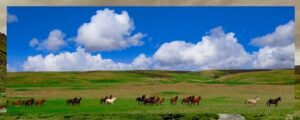 Among all the destinations in Gilgit-Baltistan to visit in 2026, Deosai National Park is perhaps the most awe-inspiring and otherworldly. Known locally as the “Land of Giants,” this vast high-altitude plateau is unlike anything else in the world.
Deosai Plains lie between the Himalayan range and the Indus River, surrounded by majestic snow-capped peaks and lush green meadows filled with flowers. After the Tibetan Plateau, Deosai is the second-highest plateau in the world, located at 4,114 metres above sea level, covering 3,000 square kilometres.
Deosai is home to a wide variety of fauna and flora. Travellers are encouraged to keep a lookout for Himalayan brown bears, red foxes, and ibexes that are known to inhabit the region. The area is filled with wildflowers blooming everywhere, making for a very photogenic environment. The shimmering Sheosar Lake, sitting at the heart of the plateau, is one of the most serene bodies of water you will ever lay eyes on.
Deosai is accessible only between June and September due to heavy snowfall in other months, so plan accordingly.
Best time to visit: June–September
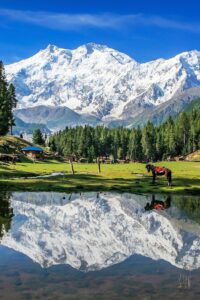 If Gilgit-Baltistan is a paradise, then Fairy Meadows is its most magical corner. This lush green alpine meadow, perched at an altitude of 3,300 meters in the Diamer district, offers one of the most iconic views in all of Pakistan, the towering south face of Nanga Parbat reflected in crystal-clear mountain air.
Fairy Meadows is a hiker’s paradise near one of the Nanga Parbat base camps. It can be reached by jeep and a three-hour hike from Raikot on the Karakoram Highway, and has been declared a national park by the Pakistani government.
Waking up in a tent at Fairy Meadows with Nanga Parbat, the world’s ninth-highest mountain and famously known as the “Killer Mountain,” filling your entire field of vision is the kind of experience that redefines what travel can be. For those seeking more adventure, the trail continues to Nanga Parbat Base Camp itself, rewarding trekkers with close-up views of one of the world’s most dramatic peaks.
May to October is perfect for hiking trails in Fairy Meadows. The jeep track leading to the trailhead is steep and thrilling in itself, a proper adventure before the adventure even begins.
Best time to visit: May–October
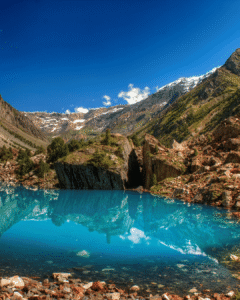 Often overshadowed by the more famous Hunza and Skardu, Naltar Valley is one of those hidden gems among the destinations in Gilgit-Baltistan to visit in 2026 that rewards those who make the detour.
Naltar Valley is a beautiful region of alpine forests with lush green landscapes, mesmerizing flora, snow-peaked mountains, milky glacial cover, and rich biodiversity. The valley is home to three stunning lakes, Naltar Lake, Lower Naltar Lake, and Bashkiri Lake, each a different shade of blue and green, set against a backdrop of pine forests and towering peaks.
In winter, Naltar transforms into a ski resort and hosts national skiing competitions, making it one of the very few skiing destinations in Pakistan. In summer, the meadows are alive with wildflowers and the air is cool and clean.
Best time to visit: June–September (summer); December–February (skiing)
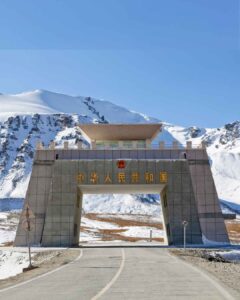 No trip to Gilgit-Baltistan is complete without driving up to the Khunjerab Pass, the highest paved international border crossing in the world at 4,693 meters above sea level.
Hunza is also the gateway to the Khunjerab Pass: the highest paved border crossing in the world. The road leading up to it is part of the legendary Karakoram Highway, often called the Eighth Wonder of the World, which snakes through some of the most dramatic mountain scenery imaginable. The pass marks the border between Pakistan and China and sits within the Khunjerab National Park, where you may spot Marco Polo sheep, snow leopards, and Himalayan ibex in their natural habitat.
Best time to visit: May–October (the pass is closed in winter)
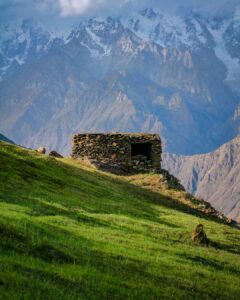 Sitting across the Hunza River from Karimabad, Nagar Valley is beloved by trekkers and hikers for its raw, unspoiled beauty.
Nagar Valley lies at the foot of the stunning Rakaposhi peak, soaring to 7,788 metres, making it one of the tallest mountains in the region. A favourite among trekkers and hikers, the valley features winding trails that meander through lush meadows, sparkling streams, and snow-capped summits. The trek to Rakaposhi Base Camp is renowned for being one of the most breathtaking in the area.
The Hopar Glacier and Hispar Glacier are also accessible from Nagar, offering multi-day glacier treks for those seeking serious adventure.
Best time to visit: June–September
In summer, June through September, is the peak travel season when every destination in Gilgit-Baltistan is open. The meadows are lush, rivers are full, and mountain roads are entirely accessible. Autumn paints the valleys in orange, gold, and crimson hues, offering spectacular views and fewer crowds. If you can visit in October, you will be treated to one of the most beautiful color displays in the natural world, with far fewer fellow travellers to compete with.
Gilgit-Baltistan is not merely a travel destination; it is a transformative experience. From the legendary grandeur of Hunza Valley and the surreal wilderness of Deosai Plains to the magical silence of Fairy Meadows and the hidden forests of Naltar, the destinations in Gilgit-Baltistan to visit in 2026 represent some of the finest natural and cultural treasures anywhere on Earth.
For adventure travelers, the territory represents the most concentrated collection of extreme trekking and mountaineering objectives anywhere on Earth. For cultural visitors, the centuries-old Silk Route heritage, ancient forts, and distinct regional cuisine offer a different but equally rewarding experience.
Pack your bags, charge your camera, and prepare to be humbled. Gilgit-Baltistan awaits.
BOOK OR CUSTOMIZE YOUR TREK, TOUR, OR EXPEDITION WITH PAMIR CREST